final

week twelve – thursday 17th october

So. We are all angry. Angry at the world, at people, at systems of oppression – the list goes on. We are told we are too sensitive and that we simply need to move on.

fuck that.


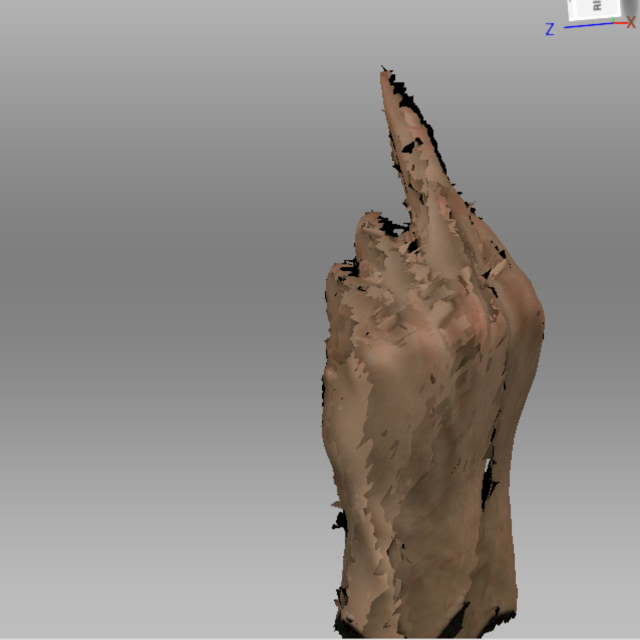
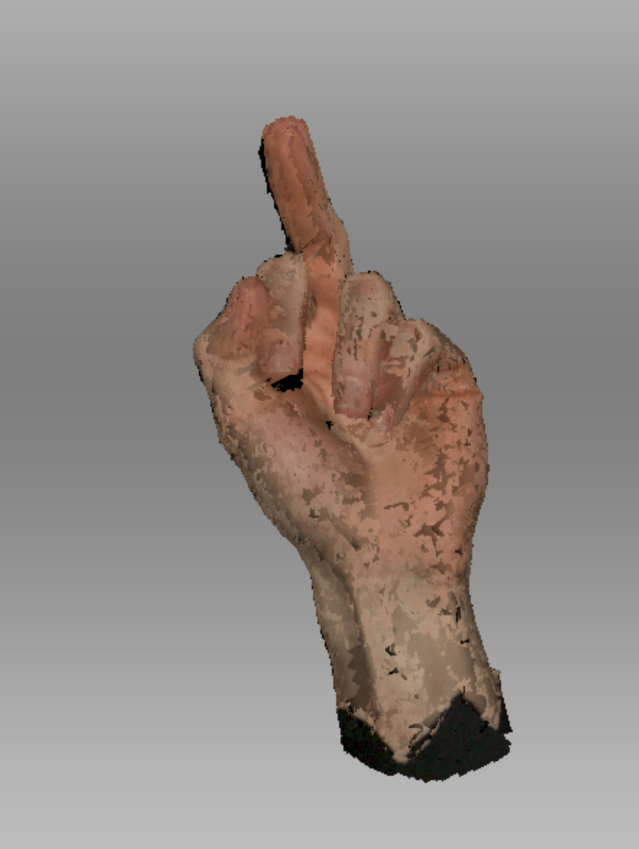
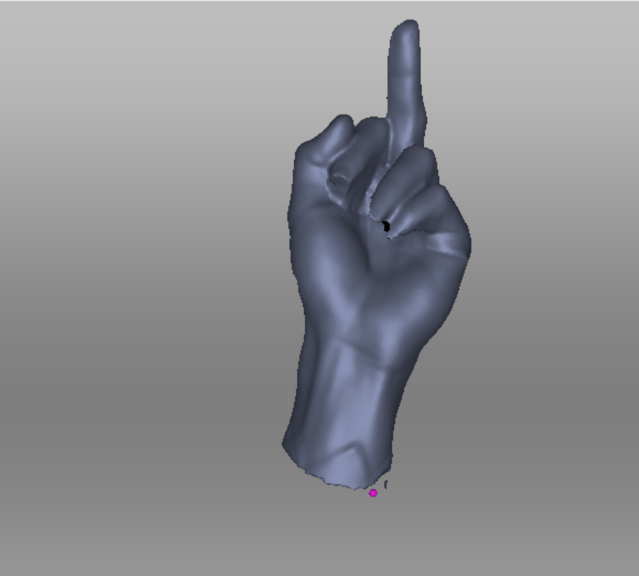
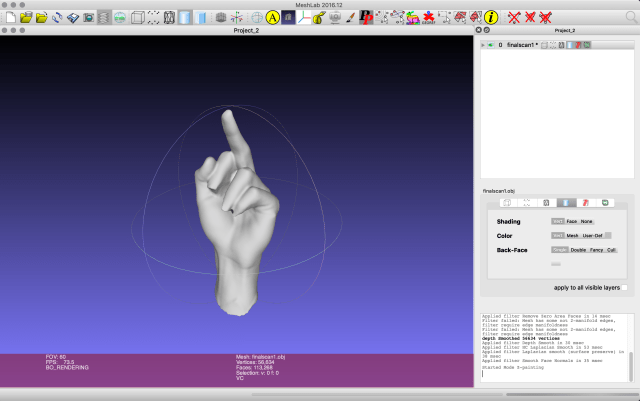
I have collected data from a handful of people around me to generate a booklet of anger. Because we deserve to say how we feel. I then took a 3D scan of a friend pulling the finger, this was to be the icon/design element of the booklet.

data
I measured the length of their middle finger and what/who they wanted to pull the finger at. This was what people said:

Caspian – 11cm – his collarbone 
Harry – 11cm – chlorinated water
Liam – 11.5cm – responsible sleep schedules
Lauren – 9.6cm – animal abusers
Aidan – 11cm – climate change
Bronte – 8.6cm – trump
Ellie  – 9cm – societal expectations
Becky – 9cm – her stats paper
Zeke – 11.4cm – grades 
Keegan – 11.8cm – drunk drivers
Tertia – 10.4cm – capitalism
Andrew – 11cm – deforestation
Victoria – 9.5cm – brexit
Senna – 11cm – fake friends

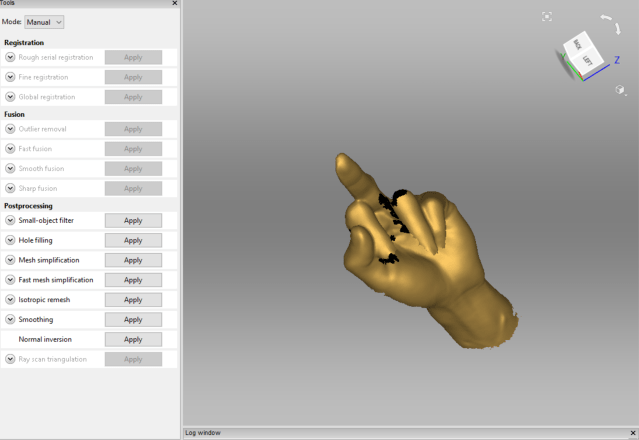
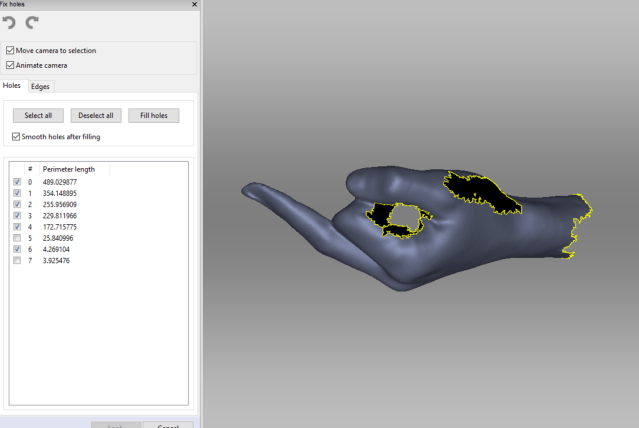
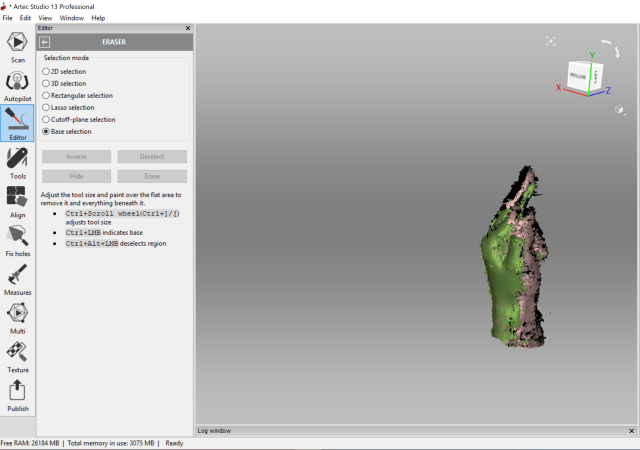
initial scan capture of hand – process of smoothing and fixing
processing
specific elements in this code that are worth taking note of include the reverting of the transform and the rotate applications to the .obj model. This enabled the hands to be drawn multiple times, where each time the transform and rotate could be reset, as to not translate further off of the last modification and therefore offscreen. (lines 64-77).
Another element is the alignment of the text arrays, rather than having them run through randomly I had to set up two seperate counters for each array and then made counter 2 = counter 1. (lines 4-7, 29-54)

Here is a video that shows off the work I did developing the lighting effects (lines 56-61)

Then based on the measurement of each persons finger (rounded to the nearest cm) I ran the code that many times, generating that specific number of hands at random size, rotation and position, which I then collated into a hand-stitched booklet.

the final print
the final booklet is printed at this small hand-held size to enable it to be shared and looked through quickly as a small coffee table book to entertain and educate people.

where to next?
If I were to continue to develop and produce this booklet I think it would be beneficial to make a series, one per month or perhaps per year to reflect changing thoughts and ideas present in society. I could branch and across generations as a visual exploration as to what pisses different groups of people off. I think that this booklet works well as a small, quick flick through book rather than a longer more in-depth piece but perhaps this output has a place alongside deeper societal investigations as a visual element.

aragog’s forest

week six – thursday 22nd august

unity: final
My final output is a development on the ‘forest environment’ created in week four. I enhanced this scene by adding a second terrain layer underneath and pulling it up to create rock forms on the mountain scene. I also painted more trees and created a small clearing in which the player begins.
I have applied various rotate scripts to both the cylinder and sphere elements of the fire, by making the cylinder a child of the sphere I was able to get it to rotate on the centre of the sphere. A range of 3D audio sources has been added to both the general forest scene and the fire to create a more immersive game experience. Directional light (moon) and point light (fire) have been used to change the scene to night.

I then went about making the scene more interactive for the player. I downloaded spiders from the online Unity Assets store which I then placed in groups around the landscape. I applied directional reaction and reaction rotate scripts (from the basics 119 pack) so that the spiders would react when the player was in range. This movement is enhanced by the application of a red point light to each spider, to give the effect that they are alive, angry and abnormal.
One larger, brighter spider is placed on the hill above the rest; this spider is inspired the title of this output, a reference to the giant talking Acromantuala ‘Aragog’ who is owned by Rubeus Hagrid in J.K. Rowling’s Harry Potter novel series.
The player’s journey is to find Aragog in the forest amongst all of the smaller spiders. This journey is initiated when the player walks through the blue floating sphere and the message ‘Can you find Aragog?‘ appears on screen. This is done using a script I wrote (with the help of youtube) in which the text GUI is triggered through the sphere’s collider when the player walks through it.

Video walkthrough: (for some reason the video won’t embed!)
https://vimeo.com/355250273

slithering dragon knot

week six – thursday 22nd august

three.js: final
This final output for three.js is a combination of two outputs made in week three, ‘dragon knots‘ and ‘purple circle‘. I combined my favourite parts of both of these outputs to create this new one, the colour scheme of ‘dragon knots‘ and the rhythmic rotation of ‘purple circle’.
Initially I was using the ‘normal (backside)‘ shading on the knot however when I applied the rotation to this mesh it showed the purple-pink frontside rather than the green-red hues of the backside that had inspired ‘dragon knots‘. In order to still have the same colour scheme and combine the rotation/opacity variables I had to create a unique lighting setup. I did this using the ‘phong’ material for the knot, changing the x and y positions of each light as well as the hue to achieve the desired result.

Unlike in dragon knots or in purple circle in this output the background was chosen as black to offer the best contrast for the bright lighting in the scene.
Choosing the opacity for the knot as it rotated was difficult as I still wanted to see the knot shape (0.7, 0.3, 0.1 opacity’s achieved this), but the lower opacity (0.01, 0.03) created a more ‘slithering’ effects which I liked also. In the final I decided on an opacity of 0.1 as you can see the definition of the curves of the knot, but it still looks as if it is curving towards you from this dark background like a snake rather than a simple rotating mesh as it would with a higher opacity.

big brother and little brother

week six – thursday 22nd august

processing: final
This final output for processing is a different version of the original ‘The False Mirror’ output generated in week two. This output generates two floating eyes, with the movement of each controlled by the mouse. This is done by substituting X and Y integer variables for ‘Mouse X‘ and ‘Mouse Y‘. These are swapped over for the smaller eye, creating a dynamic composition in which the eyes move together harmoniously but as opposites. The eye colour change is made using a series of ‘if’ statements in which an action (keyPressed) is called. I have assigned specific colours to each key to reflect a range of different eye colours.

ellipse(mouseX,mouseY, 180,180);
if (keyPressed && (key == ‘q’))
fill (91, 128, 189); //dark blue
if (keyPressed && (key == ‘w’))
fill (42, 163, 59); //green
if (keyPressed && (key == ‘e’))
fill (125, 138, 59); //hazel one
if (keyPressed && (key == ‘r’))
fill (140, 125, 50); //hazel two
if (keyPressed && (key == ‘t’))
fill (25, 90, 39); //brown
if (keyPressed && (key == ‘y’))
fill (43, 29, 7 ); //dark brown
ellipse(mouseX,mouseY, 180,180);

The repeat of the ellipse at the end of the series of ‘if’ statements ensures that a loop is created that the statements can work on. Without this last line of code the statements have nothing to apply their fill to.
The naming of this output is in reference to big brother always watching. The smaller eye or ‘little brother’ was added to create a more dynamic composition in which the pair of eyes could interact.

triangle towers

week six – thursday 22nd august

conditional design: final
Conditional design is the generation of a physical output by players that have been controlled by set conditions or rules. Variation within an output can be seen through interpretation of the rules.
My final for this output is a development of the work of the same name that was created in week one. One change that was made was the exclusion of stabilising elements, as they were not able to be clearly enough defined to improve the output. Another rule that was implemented in this final was specifying the types of triangles. In the initial game players struggled to maintain dimensions of the triangles as they changed direction. This new rule enabled the game to run much more smoothly. The final new rule that was introduced controlled the players use of other opponents tower to reach the other side. This rule was developed to prevent one player simply using the tower on the opposite side to reach their target.
In this second test of ‘triangle towers‘ it was interesting to see how the players followed the basic structure of the game up until someone came close to winning. At this point players used modifications to their tower in scale or path to advance faster and to defend.

Design a site like this with WordPress.com
Get started